


What Healthy HR Organizations See Before Problems Surface
Employees almost never email HR to say onboarding went exactly as planned. Nobody writes in to note that payroll landed correctly for the 26th straight pay period. No one thanks HR because open enrollment was uneventful.
That silence gets read as a good sign. It shouldn't be. The best HR work is invisible because nothing is going wrong, but invisible and healthy are not the same thing. Mixing them up is how organizations get blindsided by problems that were sitting in plain sight for months before anyone named them.
Reading the Weak Signals
Traditional HR reacts to complaints. Stronger HR functions look for the complaint before it's filed.
That means auditing onboarding on a schedule instead of waiting for new hires to say something feels off. It means rewriting ambiguous policy language before a manager misapplies it three times. It means watching workload and attrition patterns for early movement rather than waiting for an exit interview to explain what already happened.
This isn't really a process change. It's a shift in the question HR asks itself. Not "what's broken right now," but "what's quietly heading that direction." That only works, though, if someone is actually reading the signals, and most organizations aren't, because the signals rarely announce themselves as signals. Usually they just look like paperwork.
How Local Fixes Turn Into Blind Spots
Take a hiring process that looks standardized on paper. Every manager gets the same interview guide, the same competency framework, the same workflow.
Then small adjustments start creeping in.
One manager adds questions they personally believe predict success better. Another builds a simplified scorecard because the standard template doesn't capture what matters most for their team. A third quietly drops competency ratings altogether and relies on notes and post-interview conversation instead.
None of these choices are unreasonable on their own. Each is a manager solving a real, local problem.
The trouble shows up only once someone looks across the whole organization. Candidates applying for similar roles are now being evaluated against different criteria, which makes hiring decisions harder to compare and quietly injects inconsistency into a process that was supposed to prevent exactly that. A thoughtful improvement, repeated independently five times, has become five different processes wearing one name.
The managers didn't do anything wrong. What went missing was someone noticing that several teams were solving the same problem in isolation, at the same time, without knowing it.
That's usually how local adaptation turns into an organizational blind spot. It's often the earliest evidence that a process has stopped matching how work actually gets done. Organizations that catch this early can fix the process for everyone. The ones that don't usually find out only after the inconsistency has already become the norm.
Three Questions Worth Asking Again and Again
Instead of another audit checklist, the strongest HR teams keep coming back to three questions.
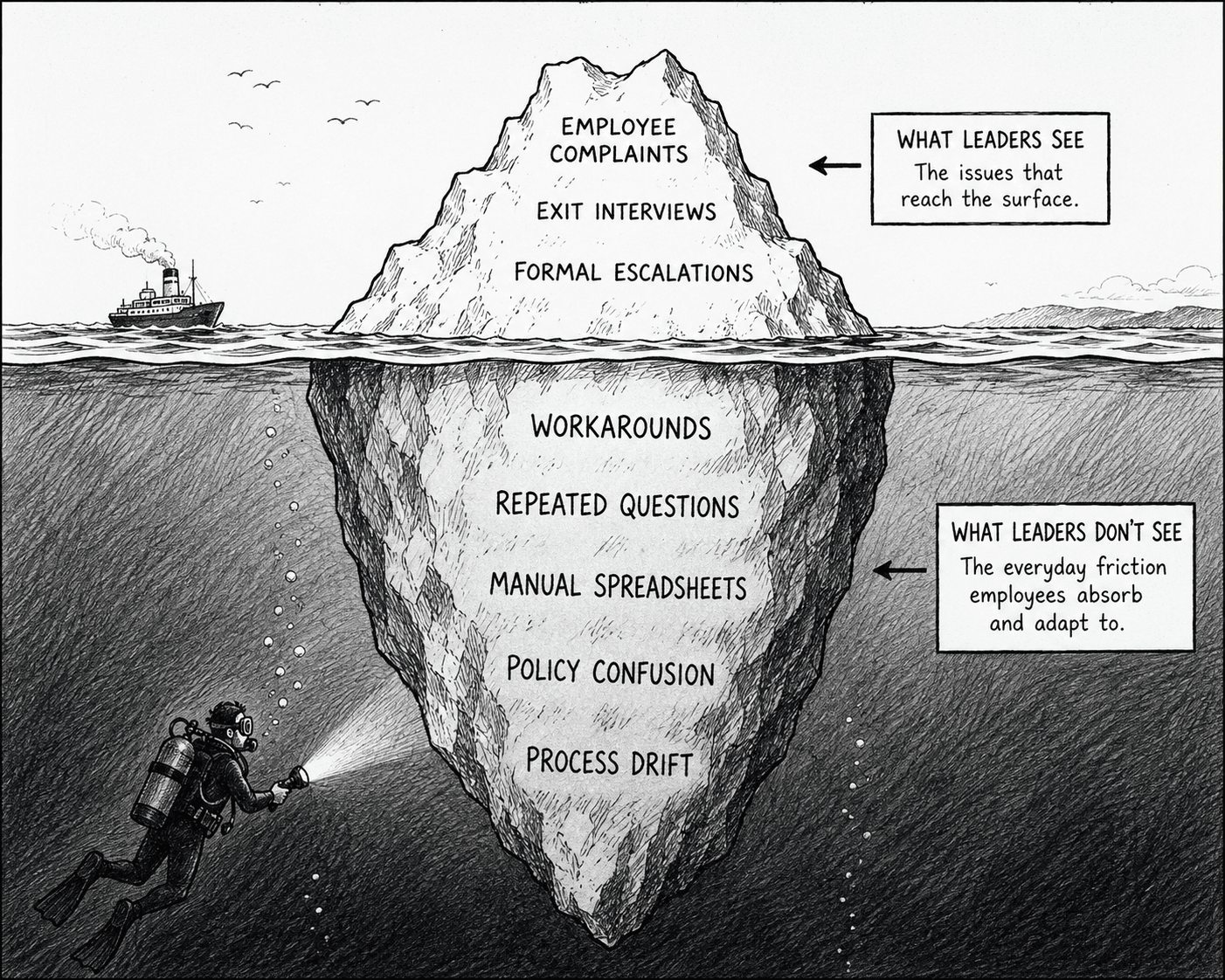
What are employees repeatedly asking us? One question is curiosity. The same question from five different managers in a month is a policy that failed to explain itself the first time. If your leave-of-absence policy generates the same clarifying email every quarter, the policy is the problem, not the people asking about it.
Where are managers building their own workarounds? Every unofficial spreadsheet and every "I just handle it this way" is a quiet vote against the official process. The workaround is often a rough first draft of the actual fix, which is exactly why it deserves a closer look instead of a memo telling people to stop.
Which process hasn't been questioned in years? Untouched processes don't stay correct just because nobody complained. They drift out of step with the actual work while the workarounds pile up quietly around them.
Not Every Signal Deserves a Response
It's worth taking the opposite argument seriously too. Not every question is a symptom, and treating every exception like a five-alarm fire is its own kind of dysfunction.
An HR team that audits every process constantly, on the assumption that silence is always hiding something, will burn its capacity chasing noise and exhaust the employees it's supposed to be helping. In my experience, usage data and ticket trends helped surface where employees were experiencing friction and where processes needed closer review. They could point us toward potential issues, but they couldn't tell us why they were happening. That part still required human judgment.
The distinction worth holding onto is pattern versus incident. One clarifying email is an incident. The same question from four departments in six weeks is a pattern. One manager's spreadsheet is a personal workaround. Three departments independently building the same spreadsheet is a design flaw dressed up as a workaround.
The skill isn't vigilance for its own sake. It's knowing which repetitions are worth interrupting the roadmap for, and which ones are just how people get by inside an imperfect system.
What HR Is Actually Being Judged On
Employees don't judge HR by how many initiatives it launches. They judge it by how easy the work feels day to day, and that judgment forms long before it ever reaches an engagement survey.
Every formal complaint represents a much larger group of people who felt the same friction, adjusted around it, and never said anything. That adjustment, the spreadsheet, the workaround, the training people quietly skip, isn't silence. It's the organization telling you exactly where it's straining, in a language most HR functions have never trained themselves to read.
The teams that stay ahead of this aren't the ones running the most dashboards or fixing problems the fastest. They're the ones who catch the signal before an employee has to explain the problem to them directly.