
CP BC
BC
BC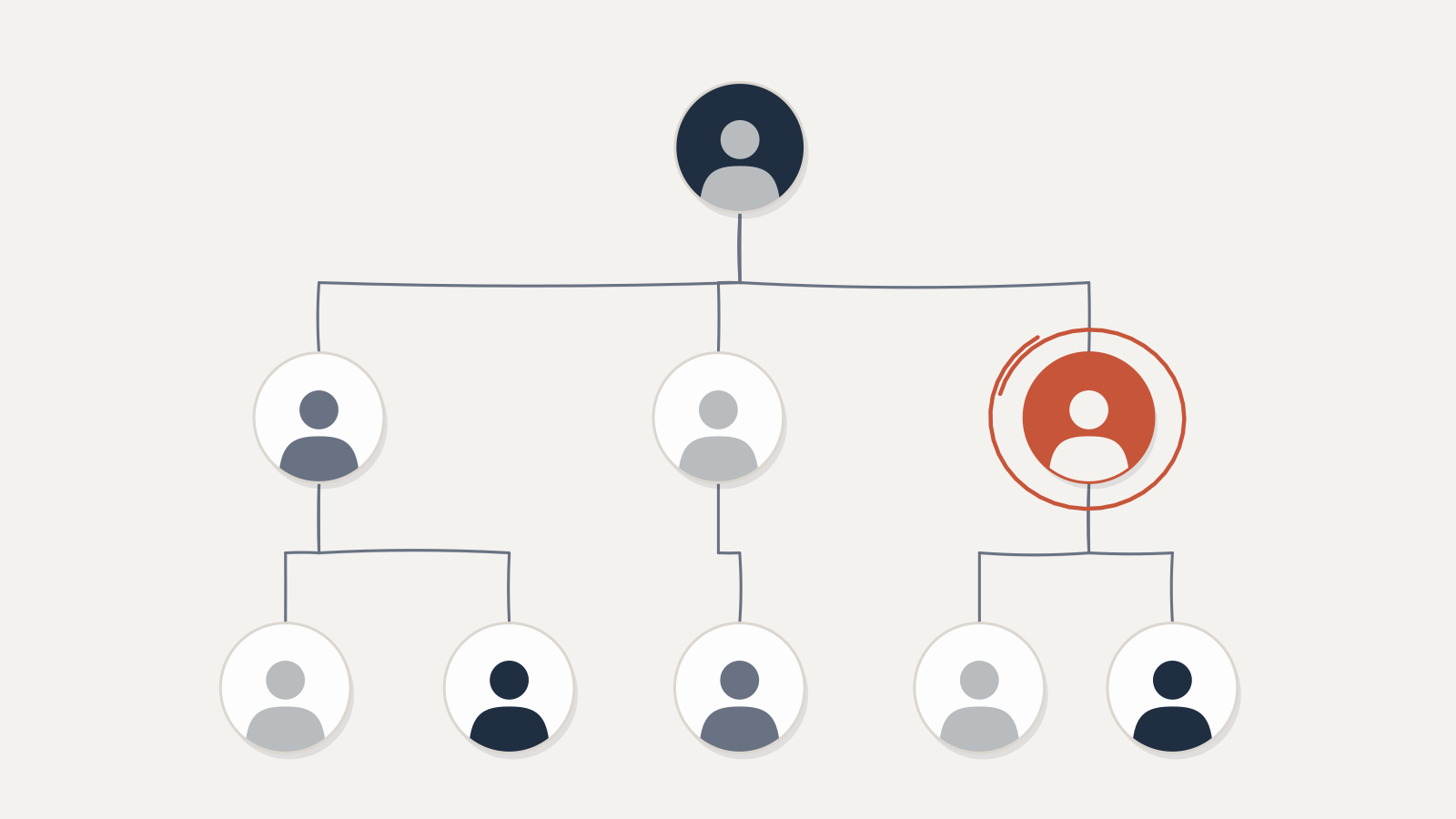
Leadership transitions can cripple operations when succession planning is treated as an afterthought rather than a continuous discipline. Chief Human Resources Officers from high-performing organizations have shared sixteen specific habits they use to build resilient leadership pipelines and eliminate single points of failure. These proven practices range from enforcing mandatory vacations that expose knowledge gaps to maintaining live skills matrices that make succession decisions faster and more objective.
BC



16 people answered: Christopher, Brian, Sean and 13 more
The succession habit that kept our bench strong was making sure every key leader built visibility outside their own team. In digital organizations disruption often comes from missing context between teams instead of unfinished work. We asked every leader to identify a successor and include that person in cross functional meetings and planning discussions. This gave future leaders a better understanding of how different teams worked together.
We found that readiness depends on trust as much as technical skills. A successor may understand the work but still struggle without strong relationships and shared context. We made sure they joined important conversations early so people knew their role before any transition happened. When the time came work continued smoothly because they were already seen as a trusted contributor.
An unexpected loss of a member from our billing/accounting department could put a heavy burden upon the facility's operational resources unless properly handled. In order for our financial tracking and payment process to continue without panic, we utilize a rigorous system of dual authorization and a segmented workflow.
A strong succession practice I have implemented is to train my General Office Managers in our high-level financial reporting applications. Each month, during our routine monthly financial reconciliation and compliance audit, each General Office Manager spends several hours assisting in entry into ledgers and auditing compliance. The simple act of training all General Office Managers has ensured that our financial bench is always prepared. Thus, regardless of whether a key financial manager leaves suddenly, our day-to-day accounting functions will continue to operate accurately and within budget parameters, providing a stable environment for the operation of our facility.
The key to preventing a disruption in workflow when there is an unanticipated leadership transition is to know who will be able to take over and handle responsibilities. As a result, my organization has developed a simple, electronic "Skills Matrix" document for tracking the skills of each member of our non-clinical staff. During our quarterly development meetings, I use these review sessions as an opportunity to update the Skills Matrix with our managers. The Skills Matrix allows us to identify which Coordinators are proficient in complex tasks. Having a clear understanding of what tasks each Coordinator is capable of performing prior to an employee leaving eliminates the uncertainty that often accompanies an employee's departure. When an Office Leader departs, we are able to refer to the Skills Matrix immediately and distribute their tasks to other qualified team members, thereby maintaining continuity and stability in our organization.
A sudden loss of leadership does not have to create panic if you are consistently communicating with every part of your facility. To maintain smooth operation, we hold an operational debrief on a bi-weekly basis. In each debriefing meeting, each administrator shares their three most active projects, as well as all upcoming deadlines via a shared online project management tool. The consistent sharing of project information via this tool will allow no single administrator to be the sole keeper of all the information. Thus, when a key manager leaves suddenly, the other members of the administration team may use the online tool to track the status of the projects they are managing. This allows for the entire administrative staff to stay informed, so that nothing falls through the cracks while maintaining a seamless operational flow at all levels within the office.
One question that has saved us from many painful surprises: "What breaks if this person does not come in tomorrow?"
When the answer is "everything," we know we have a business design problem, not a people problem.
I've never been a fan of having a succession plan in the drawer. We switch ownership of critical meetings, customer discussions, and key projects on a regular basis. Not because someone leaves, but because we do not want our business to be dependent on anyone's individual memory or connections.
At first, it may seem inefficient, since two people are doing the job, not one. But after you try going on vacation, being ill, or growing into a more responsible role, you will understand that it wasn't extra work, but insurance.
I've realized that successful companies are not based on people who cannot be replaced. Successful companies create systems which allow other talented people to jump into action with confidence. If losing one person causes total business disruption, you don't have any succession plan issues. You've created your company around a point of failure by accident.
Unexpected departures should test your leadership system, not expose its weaknesses.
I've never viewed succession planning as identifying who gets the next title. It's about ensuring someone is already growing into the next level of responsibility long before a position becomes available.
The habit that kept our leadership bench strong and ready was simple: every leader was expected to develop another leader.
That expectation wasn't reserved for annual reviews. It became part of everyday leadership. During coaching conversations, we discussed not only current performance but also future potential. Every emerging leader had growth goals, stretch assignments, intentional cross-training, and increasing decision-making responsibility. We weren't preparing people for a vacancy. We were building the capabilities our organization would always need.
Cross-training became one of our most valuable leadership practices. It wasn't just about covering an absence. It broadened perspective, strengthened collaboration, reduced dependency on any one individual, and helped leaders understand how their decisions affected the entire organization.
One question I reflected on often was, "If one of my leadership team members were unexpectedly gone tomorrow, who would be ready to step in with confidence?" If I couldn't answer that question with certainty, it wasn't a succession problem. It was a leadership development opportunity.
That reflection kept me focused on what mattered most: developing leaders instead of replacing them.
It also reinforced an important truth. Readiness isn't measured by whether someone understands the work. It's measured by whether they can exercise sound judgment, communicate effectively, develop others, and make decisions under uncertainty.
When a critical leader leaves, there should be disappointment, but not disruption. That only happens when coaching, cross-training, and leadership development are embedded in the culture rather than delegated to an HR process.
Succession planning isn't about preparing for someone's departure. It's about building an organization where leadership is continuously developed, transferred, and strengthened. When every leader is responsible for developing another leader, your leadership bench is never theoretical. It's tested, growing, and ready.
The key here is knowing which tasks we can afford to safely put on the back burner or delegate until we find a replacement. As CEO, this largely falls to me to handle, especially when the departing leader is at the VP level, but I'll also make it a standard question in exit interviews. We'll pause as much as possible, give some urgent but less-important tasks to ambitious lower-level employees, and kick the absolutely essential stuff up to me.
Our organization does not want to have a scramble if an operational director were to leave at a moment's notice, so we rely on "living" documentation for this reason. The way our operations continue to run smoothly is by eliminating the possibility of having key jobs or processes only residing in someone's mind. A valuable habit that helps us maintain a full bench is our quarterly "SOP refresh week". During this time, each department head will spend one hour creating updates on a shared, easily-readable digital operating manual with all the daily procedures and software login information. These standard operating procedures help create a part of our culture as succession planning. As such, should it become necessary for a supervisor to be temporarily removed from their position, any Assistant Manager could use the playbook to keep the administrative functions running, without missing a beat. This eliminates any potential stress associated with an unexpected resignation, while also protecting our day-to-day operational flow.
Make Documentation The Bench
We run a small founder-led team, so we never had the luxury of a deep formal bench. What we built instead was a written record that does the job a bench is supposed to do. The thinking is simple. If only one person knows how something works, that person leaving is a crisis. If the knowledge lives in writing, the person leaving becomes a problem you manage in a day rather than a scramble that drags on for a month.
The habit that kept this real is a daily written log. Every working day, anyone who made a meaningful decision or learned something about the product, a customer, or a process writes a short entry. Not a polished document. One or two honest sentences about what changed and why. Alongside that, every consequential decision gets a written record: what we chose, what we rejected, and the reasoning at the time. Over months this becomes the institutional memory that usually walks out the door when a key person does.
We pair the writing with deliberate cross-training. No critical task is allowed to have exactly one owner who can perform it. At least one other person has to be able to pick it up cold using the written record, and we test that by having them actually do it on a normal week, not in an emergency. The first time someone runs a process they have only read about, you find every gap the writer assumed was obvious, and you fix it while the stakes are low.
The reason this beats a tidy org chart is that succession plans assume you can predict who leaves and when. You cannot. People leave for reasons that have nothing to do with your planning. A daily log and written decision records do not care about timing. They are always current, because they are written as the work happens rather than reconstructed afterward from memory that has already faded. A new hire can read back through them and understand not just what we do, but why we landed there.
The one habit I would hand any founder is this. Treat documentation as the bench, not as paperwork you scramble to assemble once a leader is already halfway out the door. The cheapest insurance against a key person leaving is a culture where the knowledge was never trapped inside one head in the first place. Write it down the day it happens, and continuity stops depending on who stays.
When a critical leader leaves unexpectedly, I ensure work continues by relying on institutionalized evaluation workflows and automated checks so the team can keep delivering without a scramble. One succession-planning habit I use is treating evaluation as an evolving asset: we continually update failure categories, incorporate edge cases, and document scenario-based reviews. We separate fast automated regression checks from deeper reviews at key milestones to preserve velocity while maintaining oversight. That disciplined feedback loop makes it straightforward for others to step in and continue work smoothly.

When an important leader leaves at short notice, work goes on, as we intentionally created a sponsorship path that builds bench strength. It begins with sponsorship—our essential succession habit: a practice of matching up-and-coming leaders with experienced and respected mentors who actively champion stretch projects and promotions, so those up-and-comers are identified and nurtured. We complement the sponsorship path with cross-functional placements in finance, operations, and strategy, along with brief stints in small-group skill-building, helping employees gain the experience and the community support required to succeed when they move into a new assignment. Promoting results dashboards coupled with engagement data helps make our managers accountable and ensures talent shortages are flagged in time to address instead of when a crisis is on hand.

The succession habit that kept leadership depth real was treating transitions as a commercial resilience issue, not just a people issue. Critical roles were mapped against revenue risk, compliance exposure, team dependency, and communication load. That quickly showed which positions needed a true second line and which simply needed cleaner process support.
I then built readiness through scenario based rehearsal. Potential successors were given realistic leadership situations to handle, including conflicting priorities, incomplete data, and stakeholder pressure. Watching how someone navigated those moments was far more useful than reviewing a development plan. It ensured continuity rested on demonstrated judgement rather than hopeful succession charts.
The biggest mistake after an unexpected leadership exit is treating continuity as a staffing problem. In most cases, it is a visibility problem. Work stalls because key commitments sit in one person's head, especially unwritten priorities, exceptions, and tradeoffs. The best protection is to make leadership intent visible in normal operations so people do not need to guess under pressure.
One practice that worked well was documenting leader standing decisions by category. We tracked what they always approved, what they delegated, and what required escalation. This removed operational hesitation and helped teams keep moving because they understood boundaries, not just tasks. Stability came less from replacement and more from reducing decision fog before vacancy happens.

We run a small remote team, under 50 people for most of our 16 years, so losing a key leader hurts more here than it would at a 500-person company where someone can quietly cover. That sharpness is what forced us to take succession seriously before we lost anyone.
The habit that kept our bench real is deliberate vacation. Anyone who owns something critical takes a full week off where they are genuinely unreachable, and the rule is that the work has to keep moving without them. That week is the audit. If something breaks the moment a person is gone, we just found a single point of failure while the stakes are low, not in the middle of a resignation. We fix it by writing down what was in their head and handing a real decision to whoever covered, not a fake one.
The reason this beats a binder of succession plans is that plans written for a hypothetical departure are fiction until they are tested. A binder nobody has run is worth nothing. A week where the second-in-command actually made the calls is proof.
The bench is only ready if you have watched it play. Send your key people away on purpose and see what falls over.

The habit that stopped scrambling was documenting where work could break instead of only focusing on who does it in daily work. We learned that succession planning often focuses on job titles. But real operational risk sits in approvals, relationships, and unwritten standards. We improved by mapping each important role to its weak points step by step.
We then trained successors to protect those weak points first in practice. We reviewed this map every quarter on time. We also checked for single points of dependence like vendor trust, budget judgment, and conflict handling. Successors practiced these situations in real work, so they were ready when someone left with full confidence.
And all the times I've lost a key leader, someone else always rose to the occasion. But until that happens, the next one above that leader, or the owner of the organization, needs to step in and get to know his people, get to know their stories, and understand that specific area so they see it crystal clear.
Then evaluate the process that will be needed to replace that individual. By getting to know everyone in that area of the company, it is likely that the person is sitting right before you. And if not, you'll have a clear picture of what you're looking for.
But it is key not to instill panic and chaos. Keep your head stoic and the process moving forward.